FIrst impressions of Shanghai
I have lived in Shanghai since 2011. I wrote the below reflections around 2011/12 on my experience of coming to live the East Asian mega-city from my home in Dublin Europe.
PLACE DIARYURBANISMSHANGHAI
12/17/20126 min read


Written some time around December 2011...
When I arrived in Shanghai earlier this year I didn’t quite know what to make of it. After a year, it still felt perplexing, full of unbelievable contrasts and seeming contradictions. Everything is fast-paced and unrelenting. The city is awash with money. Space for informality and creativity appears to be dwindling and becoming marginalized. How can such a change be observed in such a short space of time? Well this part of the world is unlike any other in the sheer speed of change and it’s embrace of information and communication technologies. In some parts of the city I’ve seen entire neighbourhoods bulldozed week after week with the poor living cheek by jowl in this limbo state as new tower blocks get built around them. But appearances are deceiving. Are these people poor? They could soon be regarded as ‘rich’ as they will have been offered a gleaming apartment in place of their run-down lane house as compensation. Everyone will be looked after in this real estate miracle.
You have to get out of the inner city to see the most interesting things – like the informal village of shipping container residents near the docks. Shanghai has the largest port in the world. So with the worldwide downturn in trade, millions of empty shipping containers are leftover – the locals haven’t wasted any time in converting them to housing, offices and shops. Also on the fringes you might happen upon a gigantic empty warehouses/factory/shipyard. I’ve heard about warehouse parties popping up at very short notice but never made it to one. The coast is far away from downtown Shanghai – 30—40km away; and outside of viewing the world’s largest port, it’s not a place I would be endeared to at all; there are no beaches or nature reserves, for example.
Another slightly less cool thing happening on the fringes of the city is the planned new towns built in the last 15 years, modeled on various European countries – British-town, Germany-town, Sweden-town, Dutch-town. I hear some of these places are just ghost towns now. China-town, (ironically?), is the most successful and vibrant. I have to say I am quite insulted that there’s no Irish-town – Maybe they could re-brand one of the vacant towns as an Irish ghost town – that wouldn’t be hard.
Making a home in a mega-metropolis
My pre-conception of living in a mega-city has been confirmed: You choose the part of the city that you want to be home - your neighbourhood, places for socializing, eating, working etc. and you rarely leave this quarter unless you have to, the rest might as well be in another city - provided you don’t fall into the trap of the commuter rat race! (which I thankfully haven’t). The thought of living in a mega-metropolis doesn’t really cross your mind often except for those rare occasions when you have to travel to another corner of the city or you find yourself on top of a skyscraper and can’t see where the city ends and the countryside begins.
My mental map of Shanghai stretches to several districts: Jingan and Changning, with a bit of Huangpu and Xuhui thrown in from time to time. This is where I spend 99% of my time. It amounts to an area equivalent to Dublin city centre (my home town) and its inner suburbs.
The image I had of Shanghai before coming here was the Pudong skyline (one which Ive never found aesthentically pleasing) but this image is not one that I perceive in my daily life here. Shanghai is a big city full of contrasts and highly diverse neighbourhoods with residential building heights ranging from 2-3 storey (townhouses) up to 30+ storeys. As Pudong is across a major river, and the office district has no appeal to me, I haven’t yet visited any of the super high rise skyscrapers over there in fact.
My side of the city – ‘Puxi’ – is that of Xuhui, Luwan and Jingan: the districts that form much of the former French Concession area (now called ‘Old Xuhui’). This is an area far removed from the gigantic and oppressive buildings and road infrastructure. It is a very green area with human –scale streets, bicycle lanes and a rich diversity of shops, cafes, bars and restaurants.
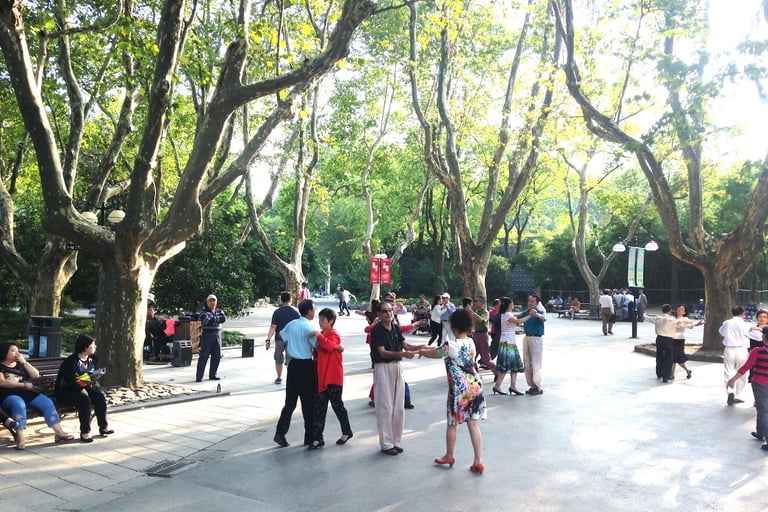
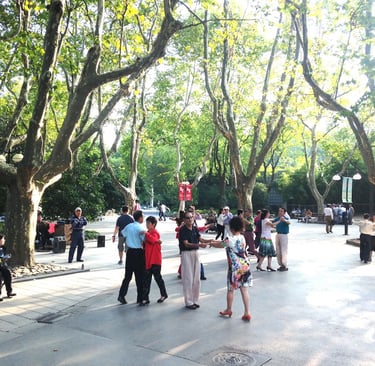
Dancing at Fuxing Park, a regular site at any time of day or night in many of the small parks that are spread around the city
My side of the city – ‘Puxi’ – is that of Xuhui, Luwan and Jingan: the districts that form much of the former French Concession area (now called ‘Old Xuhui’). This is an area far removed from the gigantic and oppressive buildings and road infrastructure. It is a very green area with human –scale streets, bicycle lanes and a rich diversity of shops, cafes, bars and restaurants.
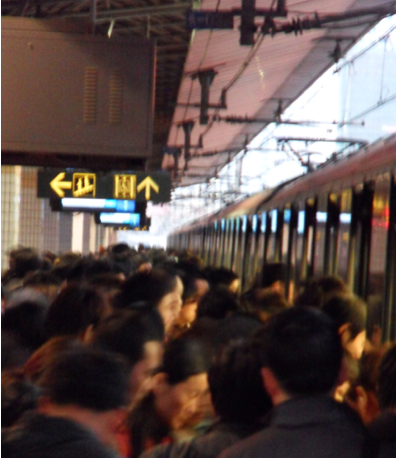
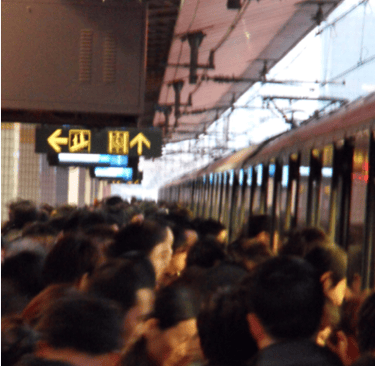
‘The mill of the century’ Waiting to get on a metro when its already full. Or trying to get out of a station when two metros have arrived at the same time leads to dangerous situations like this where there isn’t an inch of space left to breathe. This is one of the main reasons I have stopped taking the metro to work. The novelty wore off pretty quickly. I heard that at some stations, people now have to queue on the street at peak times to get in to avoid overcrowded spaces.
My side of the city – ‘Puxi’ – is that of Xuhui, Luwan and Jingan: the districts that form much of the former French Concession area (now called ‘Old Xuhui’). This is an area far removed from the gigantic and oppressive buildings and road infrastructure. It is a very green area with human –scale streets, bicycle lanes and a rich diversity of shops, cafes, bars and restaurants.


Getting my head around the Gaojia
Sometimes you think you have adapted to the scale of Shanghai megacity, then it hits you: The Elevated Highway (“gaojia”) that cuts through, carves up and rips apart inner sections of the city to make vehicular transport as efficient as possible. To anyone with a locally licensed car it represents the holy grail of transport. Non-Shanghai license plates are not allowed on it during peak hours (traffic police will often be checking at the on-ramps); Shanghai license plates have become exorbitantly expensive as they are in limited supply and there is such high demand. The points at which the elevated highways converge are vast assemblages of curved roads going up and down, twisting around giving true meaning to the term ‘spaghetti junction’; but these appear right in densely populated parts of the city. Space is at a premium; urban development is top down and transport engineers are the kings that rule the roost in facilitating mass car ownership and the perceived increase in quality of life that it comes with. But of course, the problems of this choice of hyper car-based urbanism are vast and frightening. The noise levels, the physical and psychological separation of districts, the ramps, the left-over 8-lane highways underneath being hardly used much; the masses of people living nearby; the darkness; the isolation; the sense that the city belongs to people with cars; car is king and all other considerations are secondary. These are my own perceptions and I recognize I have my own biases as a non-car owning European.
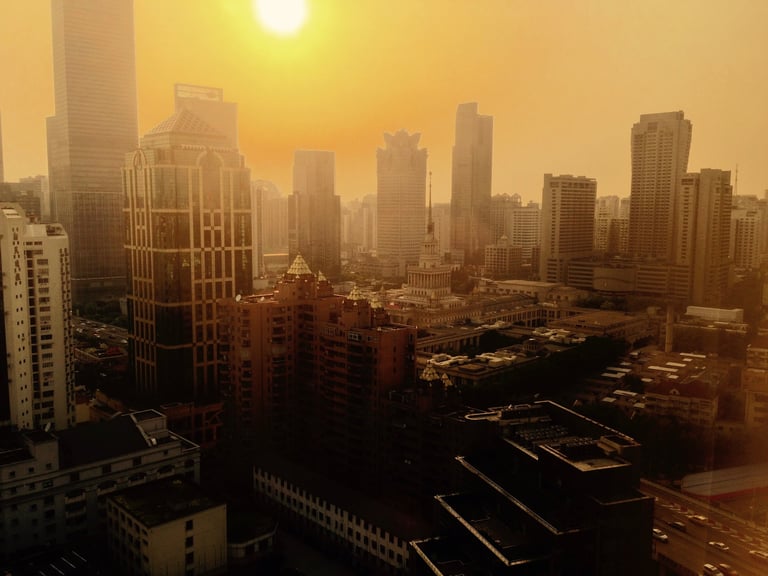
Speed of Change is the pride of a nation taking way too many shortcuts in planning for a better future
I have often thought that the is a much greater risk of an environmental (or social) catastrophe that could damage the China more so than economic recession, given the desire to develop at such a rapid pace with no exceptions, and the belief in hard engineered solutions to solve complex issues (three gorges dam and south-north water pipeline being notable examples). There is an unhealthy and dangerous government obsession with the speed of building construction and urban development in general; everywhere is in a scramble to get ahead; everyone is hyper-competitive. A highly complex city or district strategic structure plan that might take a year to complete in Europe would have delivery time of two months or less here. One developer recently announced intentions to build 100 shopping malls in 35 cities over the next five years. In the late 1980’s, following a visit to the city Deng told central government officials “the development of Shanghai and Pudong is not a regional issue, but a national one”. “To develop Pudong is to develop the Yangtze River Delta region”. Two months later, Pudong was on the drawing boards." So it appears that the drawings for one of sthe most significant national development projects ever in china took two months to develop!

