Storytelling and communications in the IT world
This post explains the fundamental importance of storytelling as a tool in IT communications, not least to bridge the gap between technical / specialist and non-specialist / non-technical audiences.
TECHNOLOGY
8/9/20244 min read


Introduction
Let me start with a story: A colleague was recently telling me about how GenAI is transforming the jobs market where, for many tech roles, what is becoming more valued than ever, is one’s ability to articulate, express, and narrate complex phenomena in a way that people can relate to. GenAI tools are now able to deliver outputs that humans once had to construct, be it lines of code, an instruction manual or a logo design. What matters more in the post GenAI world will be how we take advantage of these new tools to be more productive, more creative, more innovative etc. This had me thinking about the way in which we continue to outsource parts of our humanity to machines which are said to have some form of artificial “intelligence”. So what’s left for us? Well, in this article, (which I wrote myself without GenAI, honestly!), I am going to talk about one aspect of our common, shared humanity that is not going to be outsourced any time soon: Storytelling. And to be specific, how storytelling can be leveraged in the IT world to bridge the gap between technical and non-technical audiences.
Why stories in IT communication?
Humans have been telling stories since the dawn of time. It's actually how we make sense of the world and communicate our experiences to others. Stories help us understand who we are and where we came from. They provide context for our lives and connect us to something larger than ourselves. Stories are also the basis for cultural and social exchange within an organization and across society. In effect they are what helps shape the culture of work, and they are also how we deliver our work.
Information Technology, by its nature, is highly abstract, as computing mostly operates independently of the concrete world. Understanding the “jargon” of the IT world is no mean feat (and don’t get me started on the prevalence of three letter acronyms!). Most often, to be understood by the target audience, technical information must incorporate varying degrees of abstraction. Conceptual layering, symbols and analogies are common syntax elements of technical summaries. Imagery also goes a very long way to helping elucidate, frame, situate these complex phenomena into something that is readable and comprehensible to a wide audience.
“The human brain is on a much slower evolutionary trajectory than technology. Our brains respond to content by looking for the story to make sense out of the experience. No matter what the technology, the meaning starts in the brain. The success of any story, transmedia or single platform, relies on the resonance, authenticity, and richness of the narrative created by the storyteller (...) Stories are authentic human experiences. Stories leapfrog the technology and bring us to the core of experience, as any good storyteller knows”.
Pamela Rutledge (1)


How do IT professionals use stories?
Storytelling simplifies complexity without compromising accuracy. There are many ways in which it is used by different actors in the IT world. In agile software development and project management, the use of personas and user stories is commonplace in everyday operations. It helps the reader visualize the message. (Refer here for example: https://labspractices.com/guides/writing-agile-user-stories/).
Over the years I have worked with product support engineers who get called in when something breaks. Any good support engineer needs to be able to break down complex technical information to their management or a client; and do to so, there are four basic parts of the story that everyone will want to know:
What broke (if anything)?
Is this important? Urgent? Critical? Why? Why not?
What have we done to fix it, if anything?
What are we planning to do next and anything else needed to prevent the same problem from occurring again?
These essential elements make up the narrative of what happened, what we have done about it, and what is the next step. When we are delivering the update verbally to an audience, it becomes more imperative to frame the information in context and know the audience’s level of expertise in the subject matter.
Everyone knows that simplifying complex information is HARD! So using a story or relying on an analogy to situate, position and frame the information is often essential so that people can relate to it. Technical jargon and intricate details can alienate non-technical stakeholders, hindering effective communication.
Conclusions
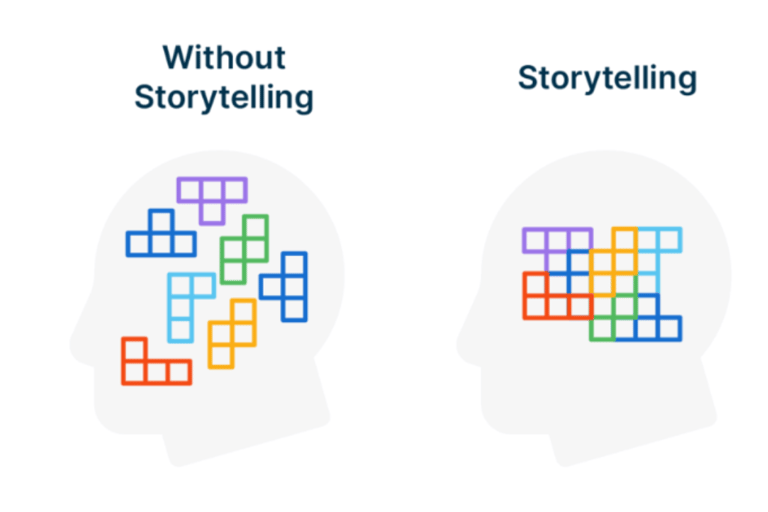
At its core, storytelling taps into the fundamental human inclination towards narrative comprehension. Regardless of technical prowess, humans are wired to respond to stories. By infusing technical information into narratives, IT professionals make complex concepts more relatable and engaging for diverse audiences. In the ever-evolving landscape of IT, and as technology continues to shape everyone’s world, effective communication between technical and non-technical stakeholders becomes at once more challenging but also more essential for individuals to thrive, and for societies to progress and innovate. Storytelling as a tool will remain indispensable for anyone trying to get ahead in the IT world whilst navigating the complexities of the digital age. A story is a language your audience speaks. Without telling stories, we may as well just be a chatbot like chatgpt.
References:
The Art of Storytelling in Tech (Forbes): https://www.forbes.com/sites/forbesbusinesscouncil/2023/10/04/the-art-of-storytelling-in-tech/?sh=341a5d0e25d6
Story Power: The Psychology of Story (Pamela Rutledge): https://www.pamelarutledge.com/story-power-the-psychology-of-story/